« While water wars may be a myth, the connection between water and political stability certainly is not ».(Wolf, 1998)
When
I started this blog, I wanted to know if the scarcity of drinking water could
lead, tomorrow, to inter-state warfare. Throughout my research, I tried to
interview people from different backgrounds (UCL is truly an international
university). I met three people, but one of them made me realise an aspect I have not though of. His name is Muhammad. He is originally from a rural area in northern
Kenya. This meeting made me realise that my study was too focused in
inter-state relations; and that I was missing a point. In fact, he told me
about a phenomenon that I didn't had in my scenarios plans; intra-state wars.
(Homer-Dixon, 2000, p.28)
By which mechanism?
In a region hit by a
growing scarcity, socio-economic conditions deteriorate, food production
stagnating or declining and a population becoming poor. This
impoverishment push rural populations to migrate to the cities
where the government would not be able to welcome them due to the lack of
resources. When I say welcome, I mean, the government is not able to mobilize
the financial resources to build basic infrastructure. (Homer-Dixon, 1995)
 |
| Mathare slum Nairobi, Kenya (DW.DE, 2012) |
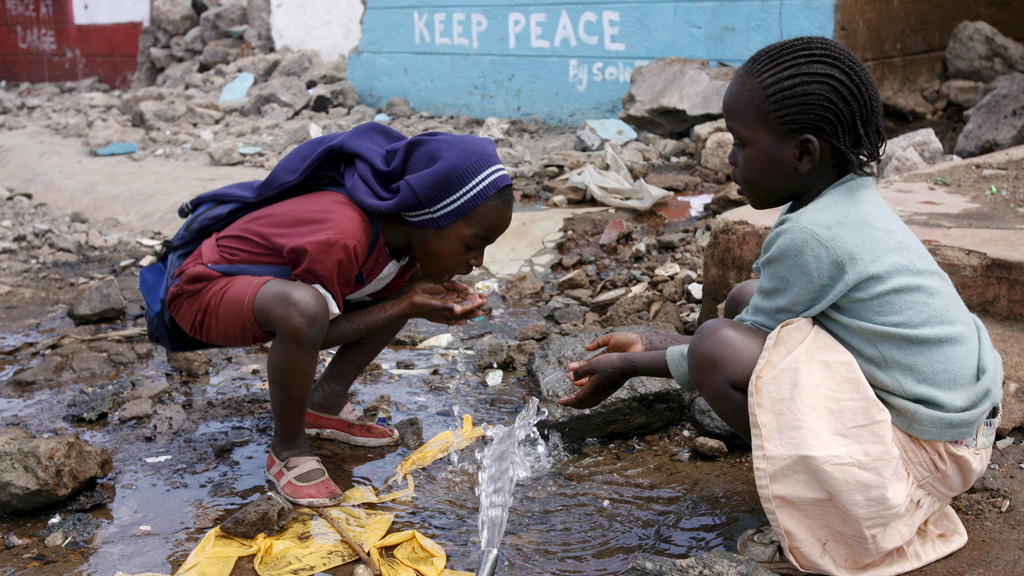 |
Kibera (Kenya, Nairobi) is Africa's largest human settlement or "slum" where water is expensive and often hard to find.(DW.DE, 2012) |
Strengthening the
vicious circle of poverty and the use of violence of uprooted
populations. This dark scenario highlights the potential role of the lack of
water in the degradation of the social fabric. It updated some of the mechanisms
that might lead, from impoverishment, rising insecurity and the progressive
inability of the government to ensure security face a rise in violence or
terrorism - Scenario pessimistic "The Coming anarchy" by Kaplan (2000).
It may be that there is no
foreseeable future "wars" of the water within the meaning of the term
agreed but the internal strife are there and probably
will go on multiplying, water being in turn the cause, the reason or one of the
components of these multiple disorders.
Homer-Dixon, T. (1995) «The Ingenuity Gap: Can Poor Countries Adapt to Resource Scarcity?» Population and Development Review, (21) 3, p. 592.
Wolf, (1998) «Conflict and Cooperation along International Waterways», Water Policy, (1), 2.
Kaplan, R. (1994) « The Coming Anarchy », The Atlantic Monthly, The Coming Anarchy, Shattering the Dreams of the Post-Cold War Era. Random House.
Homer-Dixon, T. (1999) Environment, Scarcity and Violence, Princeton University: Press Princeton.
De Villiers, M. (2000) «La géopolitique de l'eau », Paris: Revue des Deux Mondes.
De Villiers, M. (2000) «La géopolitique de l'eau », Paris: Revue des Deux Mondes.

I fear your reading is a little out of date; Kenya is a fast developing country, with much done and much left to do. There economic strength is growing, in particular in the advent of oil being discovered in northern Kenya in the past few years, how could this influence Kenya's future?
ReplyDeleteI was there last summer
Delete