ABOUT ME !

Hi! I am Radhia, an affiliate student at UCL. My major is Environment and Urban Planning Studies with a focus on water. I will be using this blog to talk about freshwater and societies. I will examine the link between the geopolitical aspect and the climate vulnerability by assessing different geographic regions. I will see how climate vulnerability link with possible future conflicts. I hope you will enjoy my blog!


Tuesday, 30 December 2014

What is your New Year's resolution?

Hello everyone! 

2015 is now approaching. So, it is time to make New Years's resolutions. Why not think about Climate change? As you know freshwater is fundamental. The Earth is, right now, at this very moment, running out of freshwater. 
Why is that? How can we change things? Here is Peppard's (2013) views about the big water issue of our contemporary world in the following video

I wish you all a happy new year. 


Thursday, 25 December 2014

How Water Scarcity Will Shape the Next Centuries of Kenya ?

« While water wars may be a myth, the connection between water and political stability certainly is not ».(Wolf, 1998) 


When I started this blog, I wanted to know if the scarcity of drinking water could lead, tomorrow, to inter-state warfare. Throughout my research, I tried to interview people from different backgrounds (UCL is truly an international university). I met three people, but one of them made me realise an aspect I have not though of. His name is Muhammad. He is originally from a rural area in northern Kenya. This meeting made me realise that my study was too focused in inter-state relations; and that I was missing a point. In fact, he told me about a phenomenon that I didn't had in my scenarios plans; intra-state wars. (Homer-Dixon, 2000, p.28)

By which mechanism?

In a region hit by a growing scarcity, socio-economic conditions deteriorate, food production stagnating or declining and a population becoming poor. This impoverishment push rural populations to migrate to the cities where the government would not be able to welcome them due to the lack of resources. When I say welcome, I mean, the government is not able to mobilize the financial resources to build basic infrastructure. (Homer-Dixon, 1995)
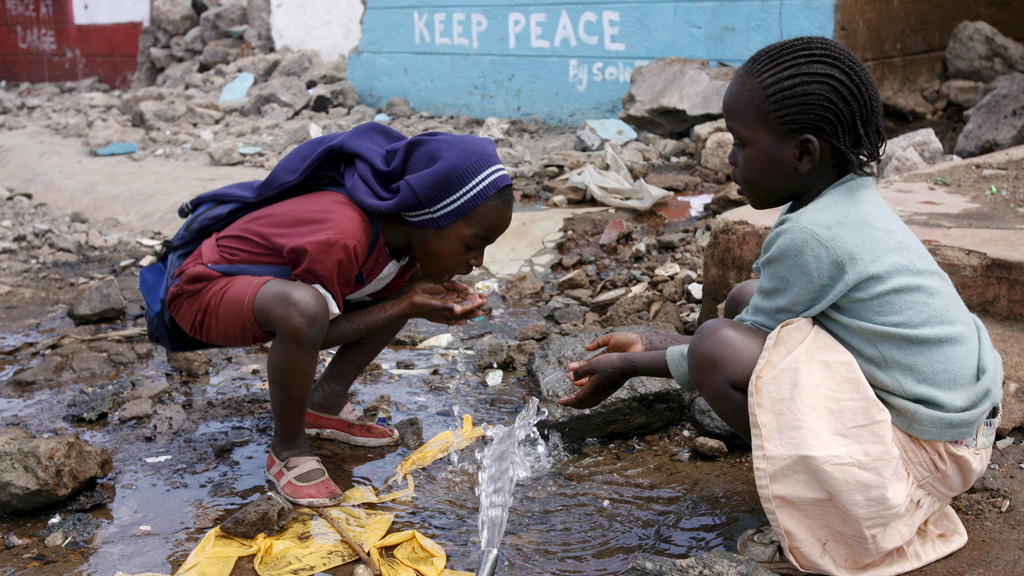
Mathare slum Nairobi, Kenya (DW.DE, 2012)


Kibera (Kenya, Nairobi) is Africa's largest human settlement or "slum" where water is expensive and often hard to find.(DW.DE, 2012)


Strengthening the vicious circle of poverty and the use of violence of uprooted populations. This dark scenario highlights the potential role of the lack of water in the degradation of the social fabric. It updated some of the mechanisms that might lead, from impoverishment, rising insecurity and the progressive inability of the government to ensure security face a rise in violence or terrorism - Scenario pessimistic "The Coming anarchy" by Kaplan (2000). 


It may be that there is no foreseeable future "wars" of the water within the meaning of the term agreed but the internal strife are there and probably will go on multiplying, water being in turn the cause, the reason or one of the components of these multiple disorders.
                                         [ Want to Know More? ]

Homer-Dixon, T. (1995) «The Ingenuity Gap: Can Poor Countries Adapt to Resource Scarcity?» Population and Development Review, (21) 3, p. 592.


Wolf, (1998) «Conflict and Cooperation along International Waterways», Water Policy, (1), 2.


Kaplan, R. (1994)  « The Coming Anarchy », The Atlantic MonthlyThe Coming Anarchy, Shattering the Dreams of the Post-Cold War Era. Random House.

Homer-Dixon, T. (1999) Environment, Scarcity and Violence, Princeton University: Press Princeton.

De Villiers, M. (2000) «La géopolitique de l'eau », Paris: Revue des Deux Mondes.

Sunday, 14 December 2014

Toilet-to-tap; The Singapour's solution

Let's talk dirty! How survives a city-state of five million citizens that has no freshwater, insignificant groundwater resources and even less land to store rainwater?
Singapore had to deal with this problem, as its 50-year water supply agreement with Malaysia ended in 2011.


"About 50% of the Island’s fresh water supplies are imported from Malaysia which is subjected to ongoing negotiations."  (NEWater, 2002) 


(PUB.gov, 2010)
NEWater a Way to self-reliance

Here, no sewers that flow into the sea, Singapore has developed the NEWater project for wastewater. The project has the capacity to cover 30% of needs and is expected to triple in the next 50 years. The city-state aims to be completely water independent in 2060.
Singapore NEWater developed various physical, chemical and microbiological tests within two years, to ensure that NEWater is potable and safe (NEWater, 2002). 
 
Purification process
 
Singapore includes six treatment plants wastewater that will be gradually replaced by one that will collect the bulk of the waste water from the island by a long deep pipeline, Deep Tunnel Sewage System, crossing the whole island North to South. The water is treated through micro or ultra-filtration, reverse osmosis and irradiation with ultraviolet radiation. Aravinthan (2005) described this process as "indirect potable reuse provided .
FIGURE 2: Planned Indirect Potable Reuse, (Aravinthan, 2005)


Planned indirect potable reuse will increase natural water reserve including river, lake, reservoir, and aquifer or the incoming needs. As exposed below, the wastewater discharged will be exposed to high degree of treatment with various filters to eliminate the pollutants before the introduction into the natural water supply sources. (Aravinthan, 2005, see further reading Lal Seth, 2011)
The wastewater treatment plan is a good solution. Nevertheless, this project is very expensive for a state like Singapore. Moreover, the treatment process consume a lot of energy and chemicals. Is the project viable in the long term?

                                        [ Want to Know More? 


(1)  Vasantha Aravinthan, 2005, Reclaimed Wastewater as a Resource for Sustainable Water Management


(2) LAL SETH Bharat,2011, "Singapore taps its water", Down to Earth,   http://www.downtoearth.org.in/content/singapore-taps-its-water

(3)NEWater, 2002, Singapore Water Reclamation Study. Expert Panel Review and Findings, http://www.pub.gov.sg/water/newater/NEWaterOverview/Documents/review.pdf

(4) PUAH Aik Num, 2011, "Smart Water – Case study of Singapour", PUB rapport.