 |
| You can also have a look to another map given by Jared Diamond (2005, p.497). |
This map shows a geographical distribution of the vulnerabilities to the Global Climate change. On the one hand, we have the countries sensitive to the future climate change. We can see that Israel is the most vulnerable to future climate change. On the other hand, we have a distribution of the armed conflicts countries in the world between 1978-2008.
We can note that India is one of the most exposed countries in armed conflicts. This map reveals that Sudan is a "hot spot" . The country is facing the most severe double exposure to both climate change and violent conflict. According to Scheffran (2012), from the University of Hamburg, the questions which arise are:
- Will regions that are prone to violent conflict also become more affected by climate change?
- Could increased climate impacts undermine adaptive capacity and add to conflict?
- How do climate vulnerability and violent conflict interact in “hot spots” that suffer from this double exposure?
How can we define the trigger from non-violent to violent conflict?
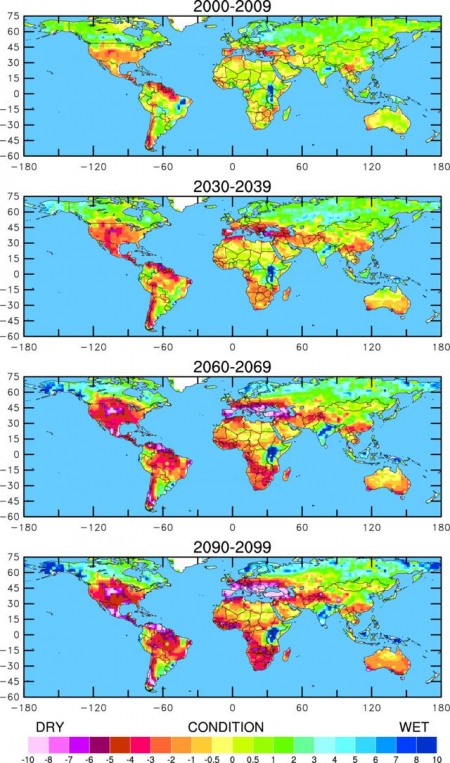 |
| "These four maps illustrate the increased potential for future drought worldwide over the decades, based on current projections of future greenhouse gas emissions. The maps use a common measure, the Palmer Drought Severity Index, which assigns positive numbers when conditions are unusually wet for a particular region, and negative numbers when conditions are unusually dry." (Climatecentral.org, 2014) |
This map illustrates what water supplies may be like, within
the next decades. Due to the rainfall declines and water bodies dry up the
freshwater will become less and less abundant. I assume that, the competition
for this resource is growing up. In this context, will this environmental issue bring civil wars? Causality is hard to measure. According to Scheffran (2012), "the lack of comparability and generalization for different regional contexts is something we have to work on. We need, more micro level data on violent conflict to understand feedback effects between climate change and conflict at subnational levels. In addition, data on social and political processes that can lead to violence are needed."
Diamond, 2005, Collapse
Scheffran, 2012, Climate change and violent conflict
[ Want to Know More? ]
Scheffran, 2012, Climate change and violent conflict

This thinking is a little reductionist assuming that geopolitically "less stable" in the regions that are the most vulnerable to climate change will necessarily perpetuate conflict. The example of Israel, there are historical and ongoing factors to consider; alliances (US-Israel), control of Palestine's water supply, the comparative wealth and military strength of Israel against the rest of the Middle-East: will water scarcity cause conflict in the region in the future, or the decades of instability that are aggravated by resource scarcity?
ReplyDeleteWater and security ( social, environnemental, political) in the middle East is a hight relevant topic. but it seems, Isreal try to solde this issue by developping transnational agrrements as The Peace Canal ( have a look on my post about Israel). Let's hope it works.
ReplyDelete